Still Waters Run Deep: Early Okavango Delta Flood Update
Up to 1, 700 km.
That is the furthest journey a single drop of water will take to reach the southernmost fingertips of the Okavango Delta. From way up in the Angolan Highlands, through the Caprivi Strip in Namibia, and into Botswana to quench the thirst of the parched Kalahari sands. The 4-7-month cross-country voyage of water brings a dynamism and kind of magic that can only really be felt when your bare feet touch the sand of this iconic landscape – one of the world’s largest inland deltas.
It’s hard to really quantify what this amount of water actually translates to. We see the still puddles, tranquil lagoons, the trickling waterways and the rivers. What we do not see is the groundwater beneath.
This incredibly flat landscape (read more about it here) is ultimately an alluvial floodplain that is made up of sand. Lots of sand. Up to 300 m deep. Sand and sediment that has travelled the length of this water system – all of which needs to be saturated before we get to see that leopard lapping up water from a puddle, or a giraffe dramatically lifting its head up after drinking for a little too long.
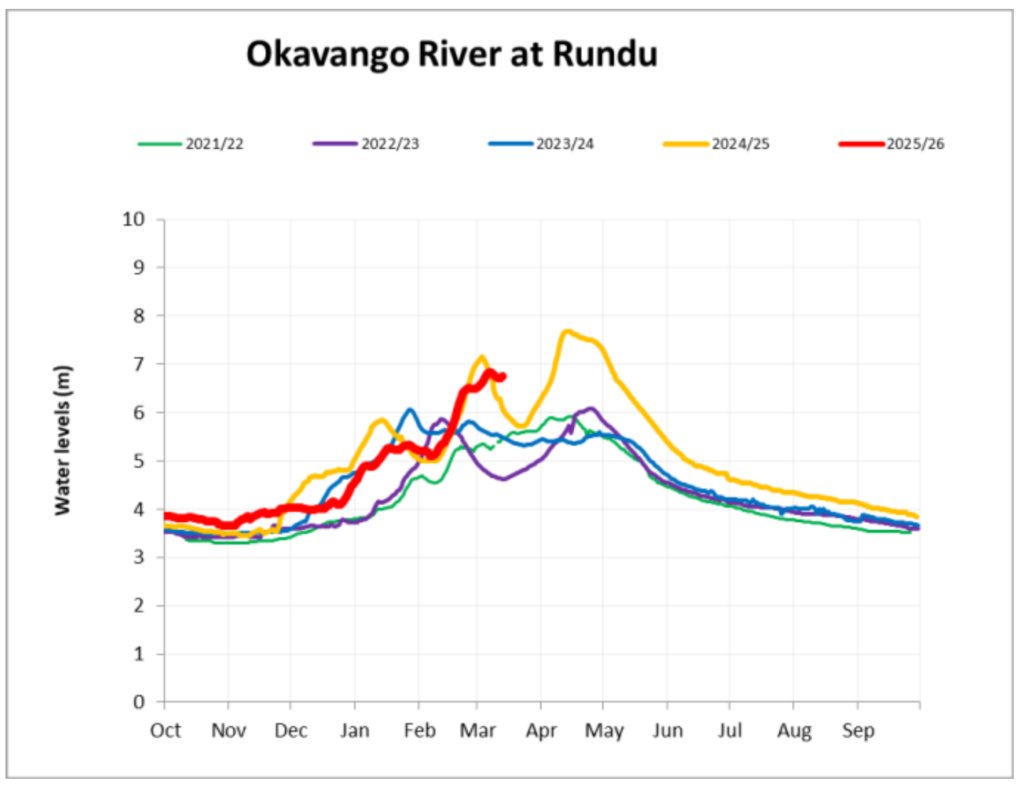
Courtesy of Namibia Hydrology, we’re looking at extended higher water levels compared to this time last year.
In past years, the high levels of rain in the highlands did not necessarily result in the gift of the oh-so-celebrated floodwaters. Come the start of the dry season, the determined march of water from the highlands slowly … seeps deeply … into the sandy basin, where the celebrated waters disappear and evaporate.
Let that sink in.
But this year may be different.
There’s been rain in Botswana. Lots of it. So much so that the Ministry of Environment and Tourism informed the public of the closure of Moremi Game Reserve between the 5th and the 26th of March, as well as the closure of transport routes. These preventative measures are to avoid a high-stakes game of “stuck in the mud”, as continuous late-season summer rains see trucks, game vehicles and self-drivers overturning in these muddy conditions.
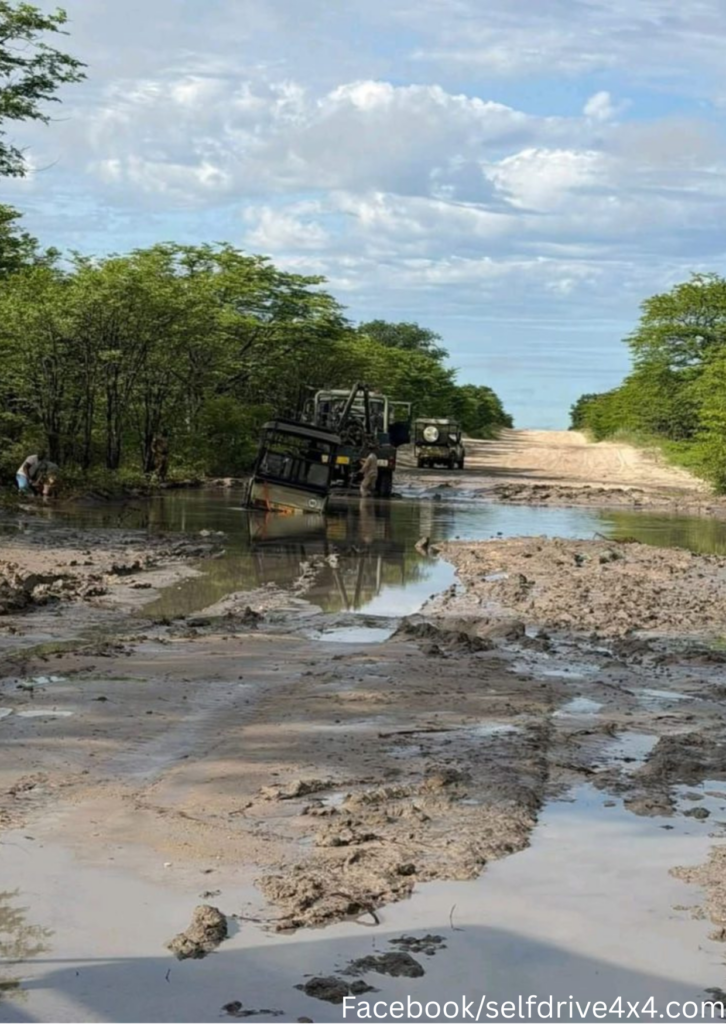
Persistent late-summer rains have caused major damage to roads, resulting in closure.
At this point, you may be wondering what this means for a mobile safari company like ourselves, with our safaris going through Moremi.
We pivot. We adapt. We get ready for an adventure.
Mababe. Chobe. Savuti. Central Kalahari Game Reserve. We are blessed with access to many more prime locations, and our team is more than happy to accommodate the changes that this unpredictable weather can bring.
And ponchos.
We’ve got you covered.
-Raf