Always Trust a Giraffe
It’s the beginning of May.
The end of the summer rains ushering in the dry season.
So too the start of peak safari season.
The flood is still making its way down.
The dynamic dance of the delta is in full swing.
The last stragglers of migratory birds are lingering around. All the extended rain has encouraged swathes of insects, resulting in some chubby birds staying a little longer than they should.
You may know that the water levels in Moremi have forced us into temporarily shifting our itineraries into Kaziikini, offering us the chance to explore some unchartered terrain for us – and wow, it is beautiful.
Soft undulating sandy hills lined with patches of dead camel thorns (Vachellia erioloba) reach their skeletal branches into the heavens, whispering softly of ancient floods that decimated them years ago.
The dead tree holds space for raptors, insects, and animals that rely on them. Nothing goes to waste.
Between them, too, the young acacias show off their bright green leaves and impressive thorns as they march off into the distance towards the flood waters.
The plains game that have been pushed to the outskirts of the delta find themselves wandering beneath. Large herds of buffalo. Dazzling zebras honk about, with the towering giraffe and elephant silently wandering in a mix of patterns, colour and contrast.
Kaziikini shares it’s western boundary – a cutline – with Moremi and is well positioned as a dry-enough refuge for animals being exiled to the corners of the delta from the pushing flood waters.
With all the plains game, there had to be predators, right?
We saw some some signs. Heard some sounds. But with the long grass, sandy substrate and a vast new playing field, locating predators proved difficult. But you can always trust a giraffe.
It was a noisy night. The cacophony of owls echoing around camp. Hyenas called throughout the night, clearly up to no good, their sounds congregating near the elephant carcass close to camp. Some faint sounds of lion drifted through the distance too – nothing worth pursuing. However, with all the noise from the night before, it was a surprisingly slow start to the morning.
So there we were, bouncing along the sand on a colder-than-usual early May morning. Seas of grassy hills. Sandy riverbeds and eye-high wild sage.
What a peculiar-looking giraffe.
Just standing there, staring in the direction of us from a distance.
We stare for couple more seconds.
One of the more experienced Letaka guides, Bate, takes a breath and begins to speak.
“Usually when a giraffe looks as perplexed as this, there is often a predator, potentially a lio-”
And out of the sage, one walks – a younger male lion with is growing mane swaying with the cadence of his stride.
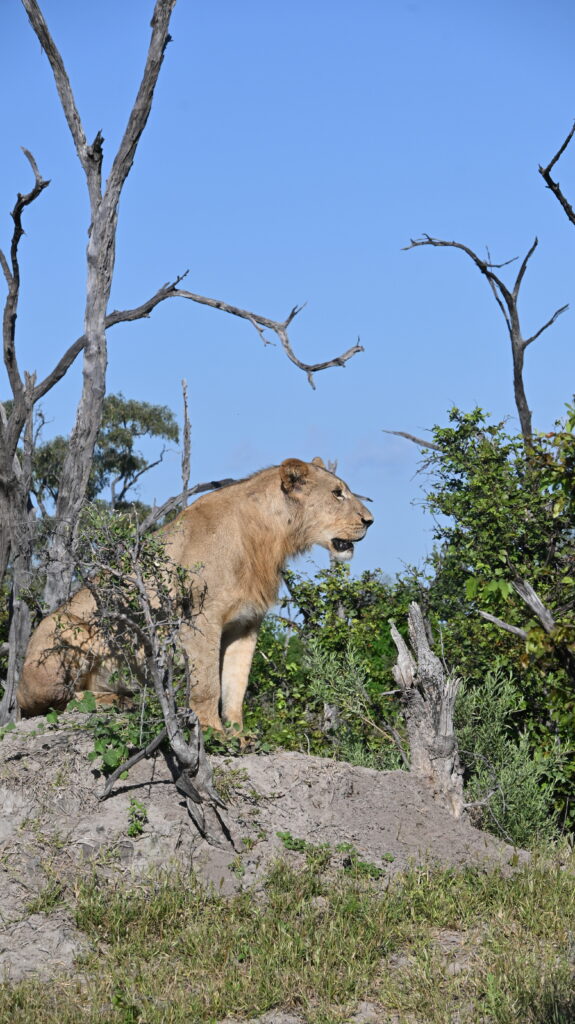
Kaziikini Lion
This was no coincidence.
Two years earlier, almost to the day, the same situation happened with Shaka – another Letaka legend. A peculiar looking giraffe, staring almost through us, the guide reads the behaviour and boom. A lion.
Now you’ll read in the field guides that the giraffes’ long necks help them see far into the distance, which seems obvious right? But learning to trust them – that’s something you learn from spending time with them in the wild.
Spread your wings.
Raf out!